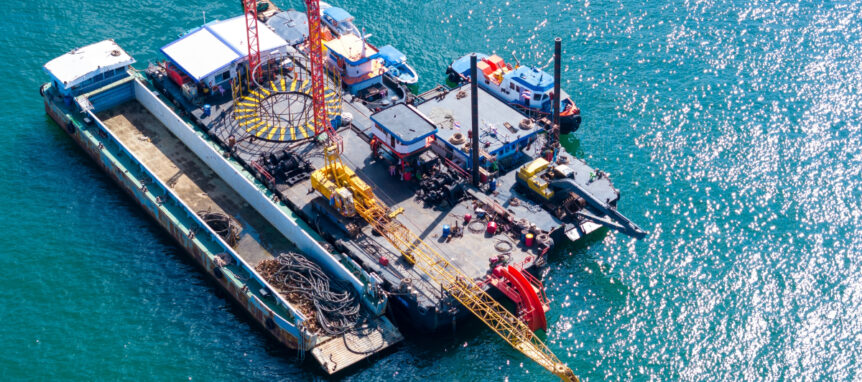
BRILL & RINALDI, The Law Firm recently resolved a significant maritime injury case involving a barge captain and deckhand who was seriously injured while working aboard a barge on Florida’s Intracoastal Waterway. The worker was following orders and removing chains from a piling when a pile-driving hammer suddenly dropped onto his dominant right hand, causing devastating injuries. The case involved claims for Jones Act negligence, unseaworthiness, and maintenance and cure. It also raised a particularly important issue for injured maritime workers: the employer attempted to classify the worker as land-based and argued that his remedy fell under state workers’ compensation rather than the Jones Act. The case was ultimately resolved through a confidential settlement to the client’s satisfaction.
Why Seaman Status Matters After a Maritime Injury
Whether an injured maritime employee qualifies as a “seaman” can have a significant effect on the legal rights and remedies available after an accident.
The Jones Act provides qualifying seamen with the right to pursue a negligence claim against their employer for injuries suffered in the course of employment. Seamen may also have rights under general maritime law, including claims for unseaworthiness and maintenance and cure.
Land-based maritime workers, on the other hand, may fall under a different legal framework. This is why classification can become a major point of dispute following a serious maritime accident.
Who Qualifies as a Jones Act Seaman?
A job title alone does not determine whether someone qualifies as a seaman. Courts generally look at the worker’s actual relationship to a vessel or an identifiable group of vessels.
To qualify, a worker’s duties must contribute to the function of the vessel or accomplishment of its mission. The worker must also have an employment-related connection to a vessel in navigation, or an identifiable group of vessels, that is substantial in both duration and nature.
The U.S. Supreme Court has explained that this analysis is intended to distinguish sea-based maritime workers who are regularly exposed to the particular hazards of working aboard vessels from land-based employees who may only occasionally perform work aboard them.
This means the circumstances of the worker’s employment matter considerably. The circumstances surrounding the accident may be relevant to the overall claim, but simply being injured while standing aboard a vessel does not automatically make someone a Jones Act seaman.
The Jones Act and Employer Negligence
For qualifying seamen, the Jones Act provides a means of pursuing an employer when negligence contributes to an injury.
Unsafe work procedures, inadequate training, improper supervision, defective equipment, and failures to provide a reasonably safe workplace may all become relevant when investigating a maritime injury.
In the recently resolved BRILL & RINALDI case, the firm’s negligence claim alleged multiple failures by the employer, including inadequate training and supervision of the crane operator, failure to properly maintain the crane equipment, and improper operation of the crane.
These types of cases often require a detailed examination of the accident itself as well as the employer’s safety practices, training procedures, equipment maintenance, and supervision.
What Is an Unseaworthiness Claim?
Jones Act negligence is not the only potential remedy available to an injured seaman. General maritime law also imposes a duty on vessel owners to provide a vessel that is reasonably fit for its intended purpose.
An unseaworthiness claim may involve defective equipment, unsafe working conditions, or an incompetent crew. Unlike a Jones Act negligence claim, the legal analysis focuses on the condition of the vessel and its appurtenances or crew rather than simply whether the employer acted negligently.
In the barge worker case, BRILL & RINALDI pursued an unseaworthiness claim alleging that the barge was not reasonably fit for its intended purpose and lacked a competent crew.
Understanding Maintenance and Cure
Maintenance and cure is another important protection available to qualifying seamen.
“Maintenance” generally refers to reasonable living expenses while an injured seaman is recovering ashore. “Cure” refers to necessary medical treatment related to the injury or illness until the worker reaches maximum medical improvement.
Unlike a Jones Act negligence claim, maintenance and cure generally does not depend on proving that the employer caused the accident through negligence. The obligation arises from the employment relationship and the worker’s status as a seaman.
This is one reason a dispute over seaman status can have major consequences after an injury. If an employer incorrectly characterizes a seaman as a land-based worker, the worker may face challenges obtaining maritime benefits and pursuing remedies that may otherwise be available.
Job Titles Do Not Tell the Whole Story
Maritime employment can be complicated because workers may perform duties both aboard vessels and on land. A worker may also perform several different jobs during the course of employment.
Courts therefore look beyond labels such as “deckhand,” “captain,” “construction worker,” or “laborer.” The analysis focuses on the worker’s actual duties and connection to a vessel or fleet of vessels.
For maritime workers who suffer catastrophic injuries, properly determining their status can be one of the most important issues in the entire case.
Protecting Your Rights After a Maritime Workplace Injury
Maritime workers face risks that are fundamentally different from those encountered in most land-based occupations. When a serious accident occurs, determining whether the injured worker qualifies as a Jones Act seaman can affect the claims, benefits, and compensation potentially available.
If you have been seriously injured while working aboard a barge, yacht, commercial vessel, or other vessel on navigable waters, the maritime attorneys at BRILL & RINALDI, The Law Firm can help determine which laws apply to your situation. We have experience handling complex Jones Act, unseaworthiness, and maintenance and cure claims and are prepared to challenge improper worker classifications when necessary to protect an injured seaman’s rights.
Schedule a consultation today by calling (954) 876-4344 or filling out the online form. We have offices in Weston, Coral Gables, and Daytona Beach.
Disclaimer: The information above is for general informational purposes only and does not constitute legal advice. Every case is different, and results are not guaranteed.